
Program Schedule & Registration
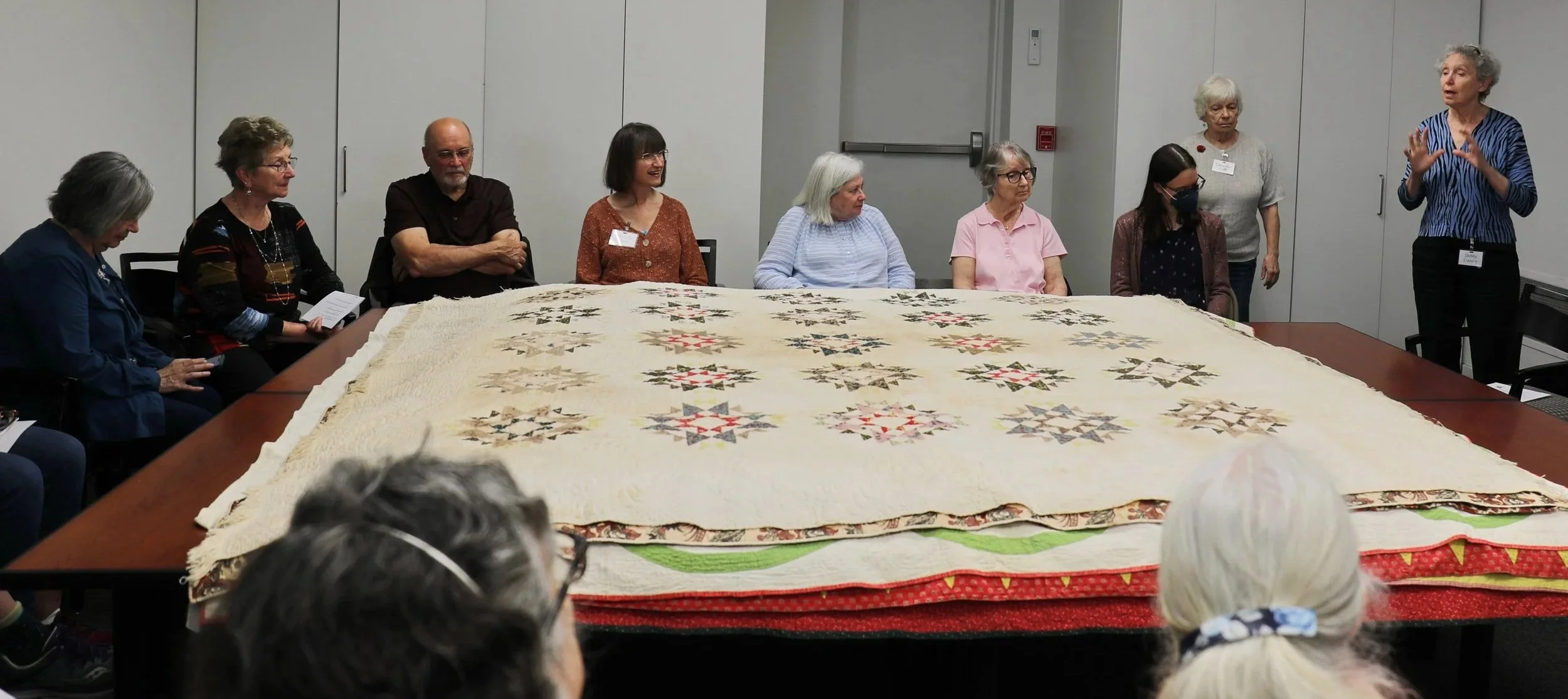
We are very proud to offer the best experts in textile history in our Penn Dry Goods lecture series. This year, you will have the opportunity to hear lectures from nationally recognized authorities in textiles. Our speakers are not merely experts in their respective fields, but are entertaining and very approachable.
All lectures require a ticket ($25/lecture purchased ahead), and tickets will be taken at the door. If you purchase a ticket the day of the event, it is $35/lecture ($25 for Claudia Dutcher Kistler’s Zoom presentation).
SLHC will issue refunds only if a lecture is canceled, OR if it is filled before we receive your registration, OR if we receive your request at least 48 hours in advance of the program.
You can pay for each lecture with a credit card below.
Paying with Check or Cash? Download, complete, and mail in your registration form.
Mail completed registration forms to:
Schwenkfelder Library & Heritage Center
105 Seminary Street
Pennsburg PA 18073
2026 Textile History Lecture Series
Thursday, May 7 (all times are EST)
7:00 — 8:00 pm Patriotic & Political Symbols on Baltimore Album Quilts, 1846–1862 (this is a Zoom only lecture)
Debbie Cooney, Independent Quilt Scholar
Even with limited participation in public life and without the vote, mid-19th century American women made their opinions known—in letters, diaries, literary works, and in their quilts. Two conflicts, the Mexican War and the Civil War bookended the production of album quilts in Baltimore, Maryland. Many of these sampler/album quilts include appliques of U.S. flags, drums, eagles, and other symbols of national pride. These quilts also include mascots of the Whig and Democratic political parties to show where their makers’ allegiances lay. We will look at fabric representations of these images in a variety of styles.
Friday, May 15 (all times are EST)
8:45 — 9:45 am Samplers with Patriotic Messages
Sheryl De Jong
2026 is the 250th Anniversary of the United States. Lots of celebrations are being planned and I didn’t want needlework to be overlooked. Some girls in the early years of our republic stitched patriotic inscriptions on their samplers and silk embroideries about Washington and others about the Declaration of Independence. This lecture will look at some of them.
10:00 — 11:00 am Knitting in the Knorth Country
Hallie Bond
Knitting was very much a part of the near-subsistence lifestyle of people in the isolated, mountainous region of New York State well into the 20th century. The story is similar to that in other parts of the Northern Forest, such as in Maine. Knitting mittens and socks was a way for women to supplement to domestic income, and knitted items appear in local store accounts as credited to the knitter’s account. There was a great market for them, of course, in this cold region, by outdoor workers, especially those in the logging industry. Styles and patterns came along with the primarily Yankee settlers in the nineteenth century, and then mirrored national trends as communication improved. Although my primary interest is in knitting and knitwear among the year-round population, we will also examine the growing appearance of knitted clothing among visitors in the late nineteenth century and early twentieth centuries when knitwear paralleled the growth of the region as a “sporting paradise.” A few knitters even adapted the technique of “buff knitting,” which appears across the Northern Forest, to other garments as the craze for snowmobiling grew.
11:15 — 12:15 am A Lifetime of Stitching:
The Needlework of Eliza Hamilton
Susan Holloway Scott
Today Elizabeth Schuyler Hamilton (1757-1854) is best remembered today as the wife of Founder Alexander Hamilton, and, after his death, as a tireless advocate for orphaned children in early 19thc New York City. But throughout Eliza’s long life – she lived to be nearly one hundred – she was also an avid needleworker, and many of the pieces she created as gifts were treasured and preserved by friends and family members. Today these pieces survive not only as a testament to the satisfaction Eliza found in handwork, but also as a unique collection that reflects one woman’s changing tastes in stitching from the era of the American Revolution to the eve of the Civil War. Several of the examples to be shown in this talk have never been publicly exhibited.
2:00 — 3:00 pm Quilt Turning—Shenandoah Valley of Virginia Quilts: Selections from the Evans Collection
Beverley & Jeffrey Evans
Beverley and Jeffrey Evans have been collecting and researching Shenandoah Valley decorative arts for over 50 years. While Jeff’s passion lies with folk art and furniture, Beverley focuses on quilts and associated textiles. The couple will present twenty-five of their favorite Shenandoah Valley quilts in a special quilt turning for this year’s Penn Dry Goods Market.
Beverley and Jeff are devoted to researching and preserving the provenance and cultural significance of every object they collect which is reflected in their connection with and understanding of the material culture of the Shenandoah Valley. The couple will share the history of each quilt in their presentation including the special story of the quilt that started Beverley’s quilt collection which has grown to over two hundred examples.
PLEASE NOTE: the same quilts will be shown in both the Friday and Saturday quilt turnings.
(Seating is limited)
The Friday session is sold out.
[Caring for Historic Textiles unfortunately had to be cancelled]
Saturday, May 16 (All times are EST)
8:45 — 9:45 am Playthings by the Yard: Cut and Sew Doll and Toy Panels of the Late 19th and Early 20th Centuries
Kathy Metalica Cray
In the late 1800s to early 1900s, many children’s favorite playthings were stuffed dolls, printed commercially and then completed at home. Ranging from animals and puppets to baby doll and tin soldier motifs, the printed-panel creations were representative of the styles and popular toys of the time, including racist caricatures. The development of lithographic printing on cloth eventually led to a cost-effective process for producing dolls and other toys. The first fabric panel doll was patented in 1886 and printed by Oriental Print Works. Later, Arnold Print Works, Art Fabric Mills, Selchow & Righter Company, and Cocheco Manufacturing were a few of the cotton fabric mills manufacturing and marketing cloth dolls and toys. Saalfield Publishing was instrumental in the production of children’s cloth storybooks. Through examination of contemporary catalogs and advertising, newspapers, panels and dolls, and quilts, this research reveals the story of these imaginative, artistic, colorful products and the aggressive marketing techniques behind them and their place in quilt history.
10:00 — 11:00 am Quilt Turning—Shenandoah Valley of Virginia Quilts: Selections from the Evans Collection
Beverley & Jeffrey Evans
Beverley and Jeffrey Evans have been collecting and researching Shenandoah Valley decorative arts for over 50 years. While Jeff’s passion lies with folk art and furniture, Beverley focuses on quilts and associated textiles. The couple will present twenty-five of their favorite Shenandoah Valley quilts in a special quilt turning for this year’s Penn Dry Goods Market.
Beverley and Jeff are devoted to researching and preserving the provenance and cultural significance of every object they collect which is reflected in their connection with and understanding of the material culture of the Shenandoah Valley. The couple will share the history of each quilt in their presentation including the special story of the quilt that started Beverley’s quilt collection which has grown to over two hundred examples.
PLEASE NOTE: the same quilts will be shown in both the Friday and Saturday quilt turnings.
(Seating is limited)
11:15 am — 12:15 pm 1876 Philadelphia Centennial Exhibition Mottoes & More
Claudia Dutcher Kistler
By 1876 Perforated Paper was a popular material used for stitching. The 1876 celebration of America’s 100th birthday inspired specific motto designs, sold only in Philadelphia, and other patriotic motto designs for needlework that were sold outside of the Exhibition. Claudia will share with you some of these patriotic mottoes and include, of course, a brief history of perforated paper needlework.
Celebrate again in 2026 by seeing what was done with needle and thread in 1876.
Note: This lecture is $15, rather than $25 as Claudia will be joining us by Zoom. ($25 at the door)
1:15 — 2:15 pm A Name in Thread:
The Social Life of an Antebellum Whitework Table Cover
Matthew Monk
Winterthur recently acquired a whitework table cover with the name "Martha Battle" embroidered upon it. This talk explores the object biography of that antebellum table cover. Collected in Arizona from a charity shop, it came with a note linking it to one of the Battle family plantations in North Carolina. There were two women within the same extended family who could have owned the table cover, underscoring how attribution matters less than the social world and complex relationships these kinds of objects reveal. Tracing the textile from plantation landscapes and North Carolina cotton mills through Reconstruction-era westward family migration and its eventual rediscovery, the talk follows the table cover’s long movement across time and place. Read closely, the embroidered name anchors the object within networks of family, power, and continuity that endured well beyond its original use.
2:30 — 3:30 pm Scrappy Ladies: Creating New Textiles with Factory Remnants
Candace Perry
(interactive presentation)
During the 20th century, factories producing clothing and other textiles were big business in our small towns throughout Pennsylvania. The women who worked in these factories were often permitted to take home scraps that they used to produce new textiles—often quilts, but also rugs and other items. Join Schwenkfelder Library & Heritage Center curator Candace Perry for an interactive program and discussion of the factories, the women who worked for them, and the projects they made from their stashes of scraps. We’ll be looking at some examples from the Schwenkfelder collection. Also, a lucky attendee at this program will be randomly chosen to win a bag made from Knoll Inc. upholstery remnants!