
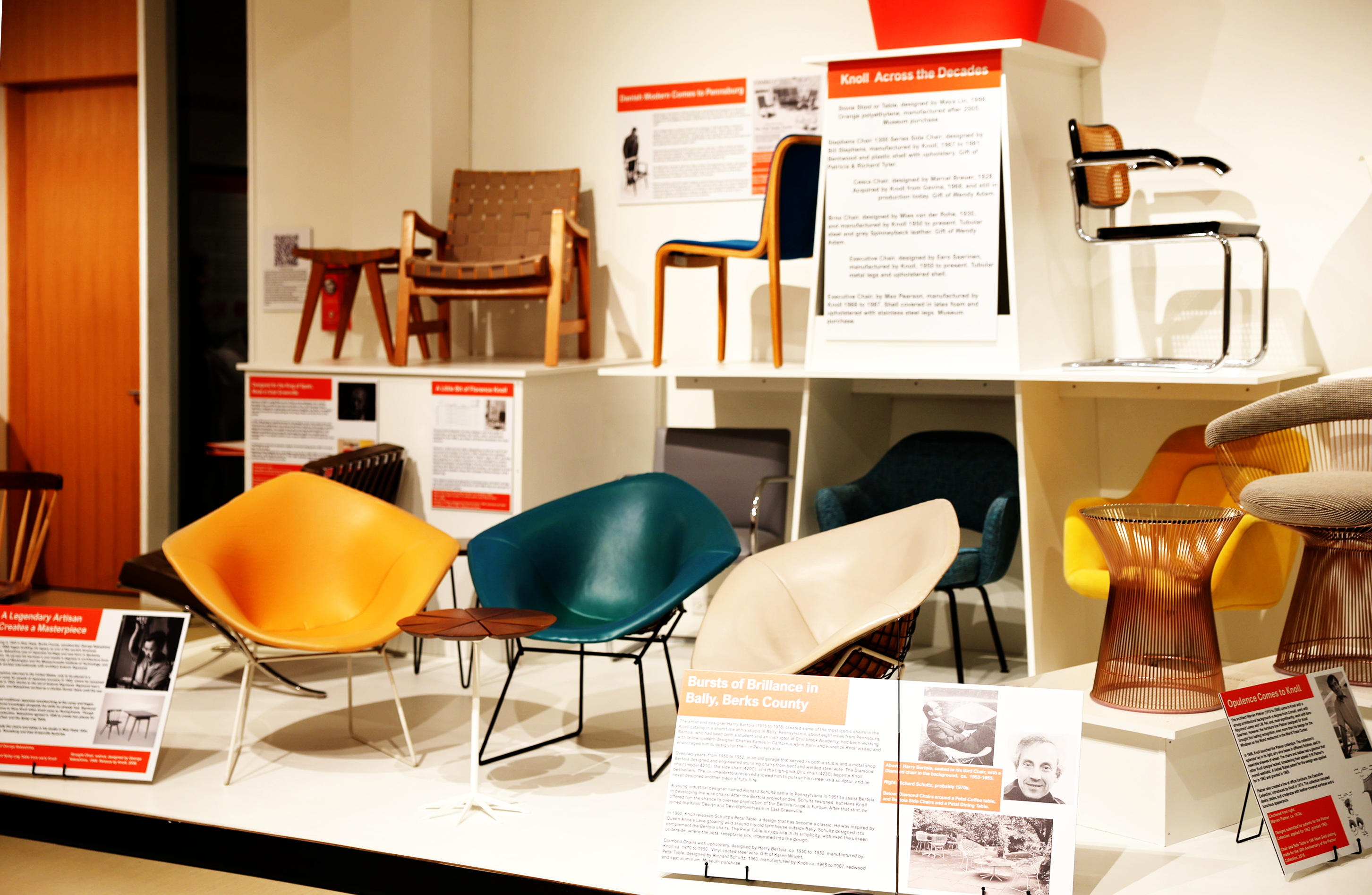
A world-famous name with hometown roots
You may have sat in a Knoll chair in an office lobby, an airport lounge, or a design museum. What many people don't realize is that some of the most celebrated furniture of the 20th century was built in the Upper Perkiomen Valley of Pennsylvania.
Our new permanent exhibit, Modern Furniture/Traditional Values: Knoll in the Upper Perkiomen Valley, tells that story. It explores how an international furniture company shaped, and was shaped by, the community it chose to call home.
Why Hans Knoll came to the Valley
Hans Knoll was born in Stuttgart, Germany, into a family of furniture makers. His father, Walter Knoll, was an early producer of modern furniture, and worked with Mies van der Rohe. In 1940, Hans opened the Hans G. Knoll Furniture Company in a small room on East 72nd Street in New York City, and boldly hung a sign calling it "Factory No. 1."
It is said that Knoll looked to southeastern Pennsylvania because of its large Pennsylvania German population, known for steady work habits and fine craftsmanship. His early production space was a modest local building (sash and door mill), and in the early 1950s the company added a plant in East Greenville. East Greenville remains a Knoll manufacturing site today.
For a museum devoted to Pennsylvania German heritage, this is a fitting story. The same values our collections document, from fraktur to farm tools, helped make a modern design company possible.
Florence Knoll and the designers who made it famous
The company's rise owes much to Florence Schust, an architect who began working with Hans in 1943. The two married in 1946 and renamed the firm Knoll Associates. Florence led its Planning Unit, which reshaped how American offices looked and worked. After Hans died in 1955, she took over as head of the company.
Under her guidance, Knoll partnered with some of the most celebrated designers of the century. Eero Saarinen created the Womb Chair and the Tulip collection. Sculptor Harry Bertoia shaped chairs from bent wire. Knoll also produced the Barcelona Chair by Mies van der Rohe, and early pieces by Jens Risom helped define the Knoll look.
The exhibit brings together iconic products made in the Valley through the mid-1900s. Seeing them up close, it's easy to forget that these sleek, modern forms took shape in local factories, built by neighbors, friends, and family members.
Hear it from the people who built it
Furniture tells only part of the story. A companion audio program shares oral histories from Knoll employees, past and present. In their own voices, they describe the craft, the factory floor, and what it meant to build world-famous designs in a small-town setting.
For many families in the Upper Perkiomen Valley, Knoll was more than an employer. It was a place where parents, children, and neighbors worked side by side for decades. These recordings preserve that local memory, and visitors may recognize a familiar name or two.
Go to https://knollpeople.stqry.app/ or dial (267) 430-9081 to listen.
An opening to remember
We opened the exhibit with a party worthy of its subject. Guests enjoyed tasty mid-century treats to match the mid-century modern furniture, and struck a pose in a photo booth featuring a Barcelona chair. A Knoll employee photo taken in 2000 drew a crowd, as guests searched for themselves and helped us identify the faces.
Best of all, the room was full of Knoll employees, past and present. The evening felt part reunion, part history lesson. Board of Directors President George Meschter put it this way:
"Of all the events we've held over the years, this was one of the very best. . . . [We] gave our community a chance to celebrate the people who worked at Knoll and to hear stories that might otherwise go untold."
Thank you to everyone who came out to celebrate with us.
Plan your visit
Whether you're a design lover, a former Knoll employee, or simply curious about your hometown's history, this exhibit has something for you. Bring a friend or family member who worked at Knoll, and share your own stories with us.
On view: Now on permanent display
Where: Schwenkfelder Library & Heritage Center, 105 Seminary Street, Pennsburg, PA 18073
Hours: Tuesday–Saturday, 10:00 am–4:00 pm; Sunday, 1:00–4:00 pm
Admission: Free and open to the public
Questions? Call (215) 679-3103 or email info@schwenkfelder.org. For current exhibits and related programs, visit our Changing Exhibits page.
Sources
- Schwenkfelder Library & Heritage Center(address, hours, admission)
- Knoll: Hans Knoll designer page
- Modernism101: brief history of Knoll