
Schwenckfeld Basics
by Allen Viehmeyer
Caspar Schwenckfeld (1489/90–1561) was impressed with Martin Luther’s reform efforts, but Schwenckfeld soon turned away from Luther. Schwenckfeld was disappointed that Luther’s movement seemed not to instill moral growth among Christians. Schwenckfeld embraced teachings of the medieval mystic Johannes Tauler and Thomas á Kempis’ The Imitation of Christ. Schwenckfeld taught a spiritual understanding of the Bible instead of a literal interpretation.
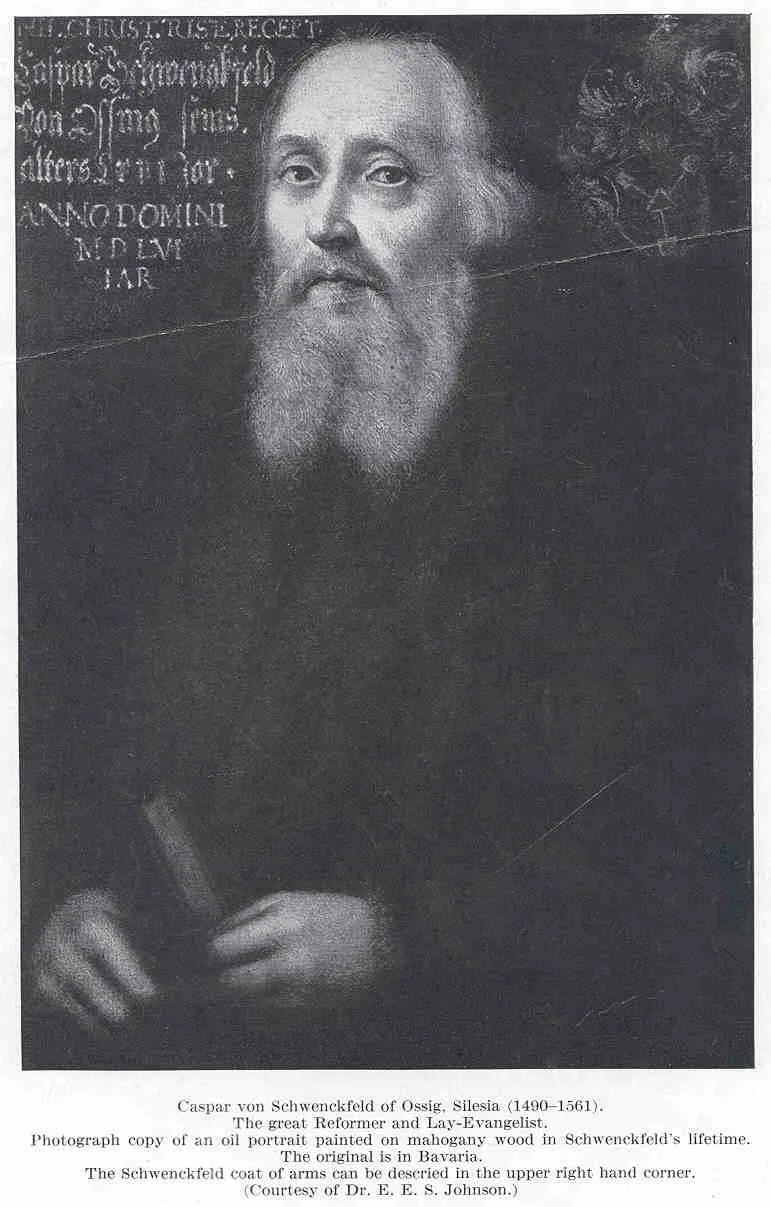
Caspar Schwenckfeld as seen in Frontpiece of Genealogical Record
Schwenckfeld promoted German over Latin in the worship service. He met people in small groups in their homes instead of in a church. They read sermons and other devotional literature. They prayed and sang hymns together. They discussed scripture in an informal way. Schwenckfeld believed that everyone could engage directly with God; a priest was not necessary. He emphasized the personal inner experience of Christ (Erkenntnis Christi) was necessary for spiritual growth; that the School of Christ is a life-long endeavor. He stressed that communion was a spiritual event; that the elements were neither physical nor symbolic. He proposed a cessation of the Eucharist should be enabled until all Christians could come to a united, common understanding of the Eucharist.